Arizona PROTECT Act Veto: What 2026 Means for VR Viewers
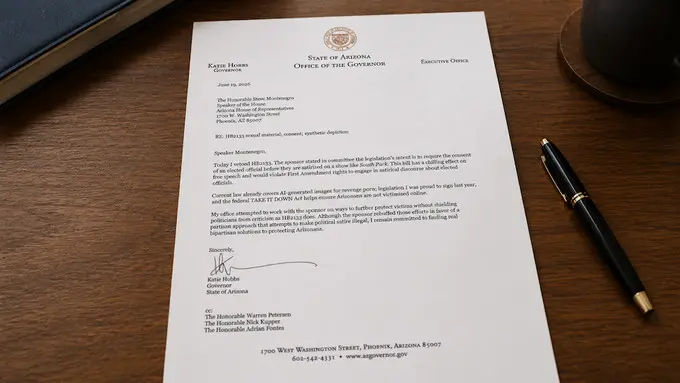
Arizona Governor Kate Hobbs vetoed HB 2133, the so-called PROTECT Act, on Friday, June 19, 2026, ending a months-long legislative fight over how adult websites handle performer age verification and consent records. The bill would have required every adult platform operating in Arizona to verify that performers were over 18 and had signed model releases, then keep those records for at least seven years. On paper that sounds like industry standard. In practice, an earlier draft of the same bill made compliance impossible — and the veto letter made clear the political problem went deeper than the legal one.
What struck me first as a viewer and someone who tracks VR platform pipelines was how close the bill came to passing despite a built-in contradiction. The original draft both demanded seven years of consent records and forbade producers from keeping identifying information after age verification was complete. Those two clauses cannot both be true. The Free Speech Coalition worked with bill sponsor Nick Kupper to remove the contradictory language in April 2026, but the underlying expansion of legal exposure remained. Industry voices flagged the real risk: applying intensive adult-platform verification protocols to mainstream platforms like X would force every photo and video upload through a moderation pipeline with model-release collection. That is not how consumer social media is built.
The Catch-22 That Almost Killed Arizona Adult Access
The contradictory provision is worth dwelling on because it explains the entire political dynamic. The bill required reasonable age and consent verification plus seven years of record retention. The same draft then forbade producers from retaining identifying information after verification. Adult platforms cannot comply with both simultaneously — either you keep the data to prove compliance or you delete it to comply with the deletion rule. The two requirements cancel each other out.
FSC Director of Public Policy Mike Stabile told XBIZ that the coalition worked closely with Kupper on amendments that preserved adult platforms' ability to block and report illegal content while removing the contradictory language. The April 2026 amendment cleaned up the catch-22. What remained was a bill that would apply industry-standard protocols to any platform hosting material deemed harmful to minors — including mainstream social networks.
That scope expansion was always going to be the political fault line. Adult platforms already run 2257-style record-keeping for legitimate performers; the bill did not invent that requirement. What it did was extend the same intensity of verification to every platform that might host adult content. Stabile's framing is sharp: a platform like X does not want to collect model releases or government IDs for every person in every uploaded video, nor moderate every clip before it goes live. The bill was never just about adult sites.
Why Hobbs Vetoed: The South Park Problem
The veto letter is unusual because it goes beyond the legal merits and addresses the sponsor's stated intent. Hobbs noted that Kupper told committees the legislation's intent was to require consent from elected officials before they could be satirized on shows like South Park. South Park episodes have included satirical scenes of President Trump in bed with Vice President Vance, and with Satan. Under the bill's framework, those scenes could plausibly be argued to fall under material harmful to minors — and the consent requirement would have applied.
Kupper amended the bill to include exemptions for parody, comedy, artistic expression, and criticism of matters of public concern. Hobbs' veto letter says her office tried to work with Kupper to protect victims without shielding politicians from criticism. He opted instead for what she called a partisan approach that attempts to make political satire illegal. That language matters because it reframes the bill from consumer protection into political speech regulation.
For VR platforms and viewers, the practical takeaway is this: the bill would have created new categories of liability that don't currently exist for adult content creators. The parody exemption sounds reassuring on paper, but Stabile observed that negotiating what is or is not comedy or artistic expression can be subjective. The veto preserves the current legal baseline — which already includes Arizona state law covering AI-generated intimate images plus the federal TAKE IT DOWN Act — without layering additional compliance obligations on platforms that already operate under industry-standard verification.
What xNight Viewers Should Know About the 2026 Legal Baseline
If you watch VR content on xNight, the legal environment you are operating in as of mid-2026 is shaped by three layers. First, federal law: the TAKE IT DOWN Act requires platforms to remove nonconsensual intimate imagery, including AI-generated deepfakes, once notified. Second, Arizona state law: existing statutes already cover AI-generated revenge porn at the state level. Third, industry self-regulation: legitimate adult platforms run 2257 record-keeping, model-release collection, and consent verification as baseline operational practice. The PROTECT Act would have added a fourth layer of state-mandated record retention and applied similar standards to mainstream platforms.
What you can actually feel as a viewer is that the protocols already in place work. When you load a scene on xNight, the performer has already gone through age verification and signed a model release. The studio has documented consent. The site has records on file. None of that is visible to you in the headset, but it is the reason the scene exists legally. The catch-22 in the original bill would have forced platforms to choose between keeping those records (legal compliance) and deleting them (the contradictory privacy clause). Neither choice was workable.
Worth noting for the privacy-conscious viewer: Hobbs' veto preserves the status quo where platforms retain verification records but are not subject to additional state-level mandates that would expand those requirements. If the bill had passed, every state-level expansion creates a precedent that other states can copy. The veto stops that precedent from originating in Arizona for now.
What This Means for VR Platforms Going Forward
The Free Speech Coalition's role in this fight is the underreported story. FSC's lobbying and amendment work with Kupper's office in April 2026 is the reason the contradictory language came out of the bill. Without that intervention, the bill would have either passed in unworkable form or killed adult access in Arizona outright. The fact that it reached the governor's desk at all — and that she had to write a veto letter addressing South Park — tells you how much the political ground shifted during the session.
Going forward, expect more states to introduce similar bills. The pattern is consistent: target nonconsensual intimate imagery and AI-generated content, then expand scope to include mainstream verification requirements that affect any platform hosting adult material. The Arizona bill is the template. The veto is a pause, not a resolution. Industry voices will need to keep engaging at the legislative level to prevent catch-22 provisions from creeping back into future drafts.
Compared to what I have tracked in earlier legislative cycles, this fight had an unusually clean resolution: contradictory language removed, bill passed in amended form, governor vetoed on free-speech grounds. The legal baseline for VR platforms in Arizona remains what it was in 2025. Federal TAKE IT DOWN Act compliance and industry 2257 record-keeping continue to govern. xNight operates under those protocols today and will continue to do so.
Free industry coverage, no subscription required — stay informed on xNight as 2026 legislative developments reshape the VR and adult content landscape.
Jessica is an experienced content writer specializing in adult entertainment industry trends, VR technology reviews, and performer interviews. With over 5 years of experience, she brings insightful analysis and engaging storytelling to every article.